A white (faranje) adoptive mother to two Ethiopian (habesha) girls wends her way through
Exotic Ethiopian Cooking by D. J. Mesfin
Showing posts with label fitfit (stew mixed with injera). Show all posts

Monday, September 27, 2010

Telba Fitfit (Flax Water Mixed with Injera)

"Telba Fitfit is a refreshing meal for a hot day or after fasting.  May act as a mild laxative." ~ D. J. Mesfin, Exotic Ethiopian Cooking, p .203


Don't get too excited about that injera -- I didn't make it!
Today's repast veered ever so slightly into the alternative medicine arena.  :)  I actually love flax seeds and we often use them on our cereal in the morning, so I had some in the freezer ready to go.  Except I forgot that when I was out shopping and bought another package (Trader Joe's has them for an awesome price).

This was a simple and quick meal to make and interesting.  It is served cold and that, combined with the presence of cinnamon, made me think that it would be a better breakfast meal than a dinner meal, despite the berbere included in it.

The first step was to take the flaxseeds:


Trader Joe's brand is much cheaper!
I poured them into a frying pan and toasted them, which smelled heavenly!


After toasting and letting them cool a bit, I threw them into the poor, abused coffee grinder:
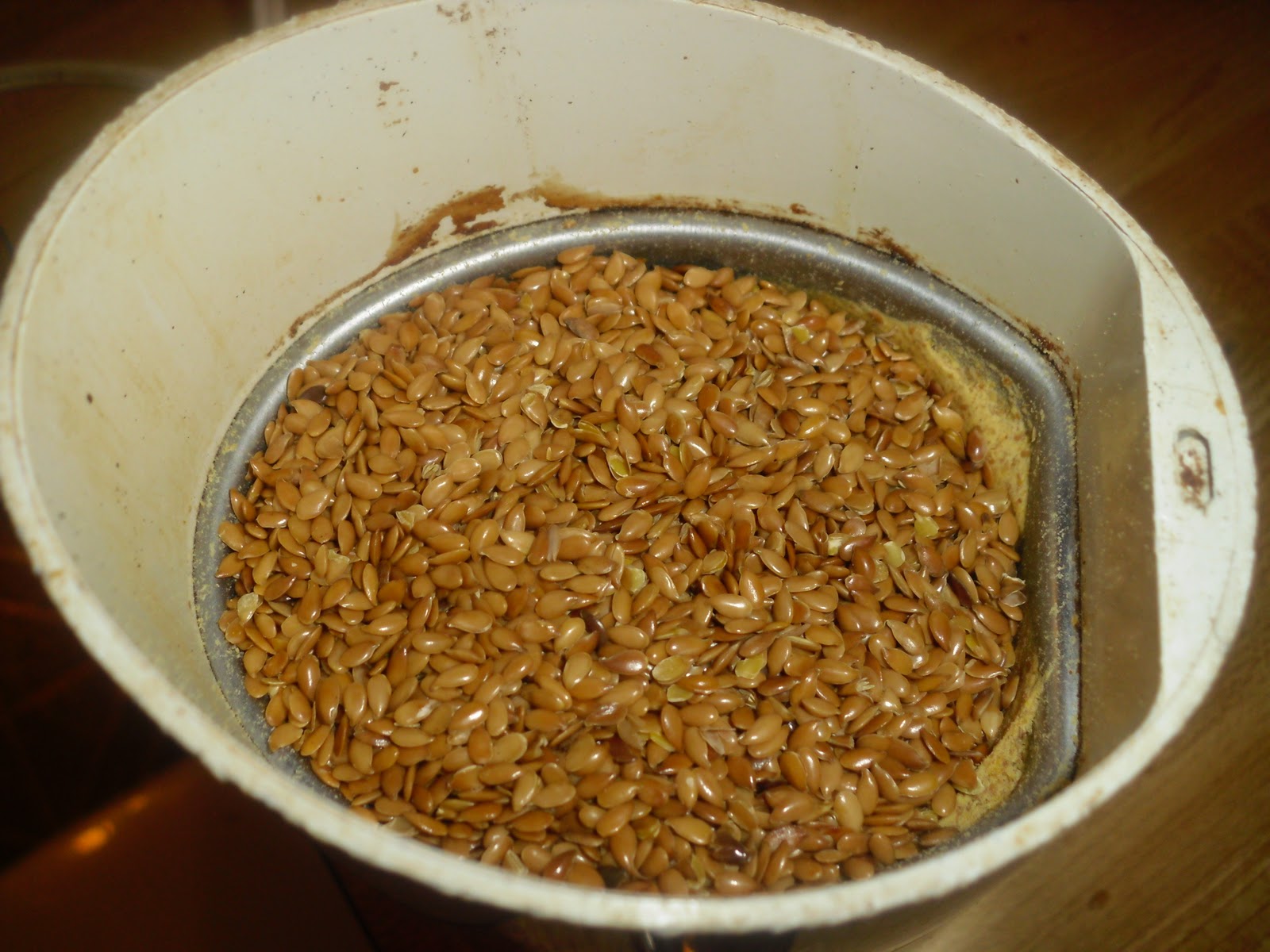

prior to grinding...forgive the battle scars/stains
after grinding
Those of you who are among my Facebook coterie may have seen a status message last Friday bemoaning the fact that I failed to clean the grinder well enough after grinding the cardamom for the yesiga t'ibs last week.  For the rest of you, what happened was that, Friday morning, I pulled out my brand new bag of Starbucks Ethiopian Limu (sadly, they seem to have done away with the Sidama and replaced it with the Limu), put the beans in the inadequately cleaned grinder, brewed, and ended up with cardamom-laced coffee, which, alone, may have been not too bad, but I had also added some chocolate milk.  It was a little too antiseptic-y and the two tastes together were not working for me!

Once upon a time, I had had two coffee grinders and kept them for separate uses, but I burned one out grinding (human-grade) puppy food for the bird's food (I have a starling).  I keep meaning to buy another one (I've decided that, in an ideal world, I should own three), but every time I'm in front of them in the store, I keep thinking I don't want to spend that whole $20 on them.  The cardamom fiasco definitely changed my mind and I resolved to fix this...until I discovered I had a second grinder all along, hidden in the plastic bin in which I keep my Salad Shooter.  So the cardamom grinder is now the official spice grinder (I labeled it and everything) and the other grinder will be my coffee grinder.  

After grinding, I added cinnamon (left), a meager teaspoon of berbere (right; usually measured in cups around here), and salt:


Then I added water:


And torn up bits injera:


I pulled the mail-order injera out of the freezer, since it lends itself quite well to fitfit.  It was only as I was preparing this dish that I thought "hmm, perhaps I should have made some injera to use to eat the fitfit".  Since injera is anything but a last minute chore, I decided to just use up the last of the mail-order injera.  Microwaving it a little bit improved its texture quite a bit, though it still left an odd residue that kind of turns us off.  

The fitfit was placed in the refrigerator until dinner time.  This was quite a filling dish and it seemed like we barely made a dent in it.  As I mentioned above, it seems like it would be a great dish for breakfast or, as the book notes, a nice cold dinner on a hot summer's day.  The cinnamon imparted a nice sweetness to it and the berbere was almost completely unnoticeable, while at the same time adding just a little something.  It's not a meal that's going to make it into our regular rotation (my husband prefers meat and berbere), but it was nice to try something a little different!  In researching this dish, I noticed it being offered as an appetizer on several Ethiopian restaurant menus, and I think that it would work perfectly in such a role.  

Friday, March 5, 2010

Yeshimbra Fitfit (Whole Dried Chick Pea Sauce Blended in [sic] Spices and Injera)

"Yeshimbra Fitfit is a refreshing meal by itself.  It is mild and nourshing." ~ D. J. Mesfin, Exotic Ethiopian Cooking, p. 212


I adore fitfit (stew mixed with injera); my most favorite Ethiopian dish is doro fitfit, the country's national dish (doro/chicken stew) mixed with injera.  It's my "usual" when we go out for Ethiopian.  


Last time I was on, I mentioned that we weren't too thrilled with the injera we had mail-ordered.  The Ethiopians complained about a residue left on their fingers and tears started flowing when the injera, instead of being supple and elastic, more or less crumbled when they attempted to fold it around their food.  So, despite having 20 pieces still left in the freezer, I decided to go back to getting injera fresh from our local restaurant (unless I make it myself), relegating the mail-ordered stuff to use in fitfit.  How timely it was, then, that Random.org landed me right on a recipe for fitfit!


This is a very simple, very standard wet to make.  There are no exotic ingredients to try to find and the preparation is straight-forward.  


As with most wets (at least in this book), this one started off with a large quantity of red onion:


In Ethiopian cooking, you apparently never sauté the onions in oil or butter, though fat is used later on in the cooking process.  Instead, you throw them into a dry pan and cook them that way, keeping a good eye on them and stirring them nearly constantly, as they are not supposed to change color (by that, they mean brown; they do become translucent as they are cooked).  

After the onions, I added sunflower oil and water:


And dried chickpeas:


After letting it boil for 10 minutes, I was supposed to add some garlic and ginger and some more water, but I got a little ahead of myself and added the spices to the mixture before it boiled:


There's also some black pepper in there, as black pepper is mentioned in the ingredient list.  It is never, however, mentioned in the recipe, so I just assumed it went in with the rest of the spices.  And while only 1/4 teaspoon of garlic was called for, I used a teaspoon because I use these and one cube is roughly one teaspoon.  

Then it was just a matter of cooking until the chickpeas became soft.  No time was given, and I had purchased them in bulk from Whole Foods, so there were no cooking directions (I know they're on the bins, but I didn't pay attention to them), so a perusal of volume 3 of my Women's Day Encyclopedia of Cookery was called for.  


This is my favorite cookbook set, from 1965.  I sometimes just sit and leaf longingly through the pictures, feeling inexplicably nostalgic for the days of dinner parties, caftans, tureens and chafing dishes, Fiestaware, harvest gold, avocado green, and Americana decor, though I was born three years after these books were published!  

According to the Encyclopedia, the chickpeas needed to cook for two hours.  Unfortunately, it also said to soak them for an hour before cooking them for those two hours, but I didn't read that until the chickpeas had already been thrown into the pot.  After all was said and done, however, they ended up simmering for about 3-1/2 hours because I had to run out to pick the Ethiopians up from daycare due to an emergency at my husband's work.  As a disclaimer, I would like to add that we do eat a fair amount of beans, but I tend to use canned for convenience's sake, and haven't cooked from dried beans in ages; that's why I needed to look it up!  You could also put the stew into a crockpot at this point until you're ready to have it.  

After we got home, I added the finishing touches.  First, some sliced Anaheim pepper:


Then the injera, which crumbled perfectly:


The finished piece:


I had to fold over the edges of the injera because it's too big for the plate!

Despite this not being a berbere dish, it was very good.  Even though we don't like the mail-order injera as platter or utensil, it worked wonderfully in the fitfit and the end result is quite filling.