A white (faranje) adoptive mother to two Ethiopian (habesha) girls wends her way through
Exotic Ethiopian Cooking by D. J. Mesfin
Showing posts with label traditional bread (injera). Show all posts

Thursday, January 27, 2011

Lemlem Zigin (Raw Beef in Spicey [sic] Sauce)

"Lemlem Zigin is a delicious meal for people who like their meat rare and at the same time favor the spicy sauce." ~ D. J. Mesfin, Exotic Ethiopian Cooking, p. 121


If I were ever to write a children's book with a concept completely stolen from someone else, it would be titled Llama Llama's Injera Drama.  It's like I've never, ever made a decent batch of injera in my life and I'm not understanding it!  I know there's a learning curve, and I'm okay with that.  But I seem to be encountering learning peaks and valleys.  I know the adage "two steps forward, one step back"; it's just not a favorite of mine.  


I had put some buckwheat injera mixture together to ferment a day or so before we were going to be making it, and I stuck to the recipe, rather than adding my husband's sourdough starter to the mix.  After last week's injera mess, I thought it was time to get back to basics.  However, I had never just used this basic recipe -- I had always added about 4 to 5 ounces of my husband's sourdough starter (his blog is here, but he isn't the best about updating it; just trust me when I say we are up to our necks in sourdough and bread around here).  I don't know why I thought I should skip it this time, but I think it was a mistake.  The morning of Ethiopian night, the dough smelled like something that had been partially digested and regurgitated.  This may have been normal, as it happened to one of my husband's starters at one time (and we could smell it from upstairs); he mentioned something about a war between good bacteria and bad bacteria.  In the end, his starter turned to the light and it stopped smelling like something had died.  If I had left this injera starter alone for another day or so, it, too, might have turned for the better, but I needed something for dinner that night, so I turned to a new recipe that didn't require any sitting, a recipe taken from Marcus Samuelsson's The Soul of a New Cuisine (there are two different links here; his name brings you to his website, while the book's link takes you to Amazon).  While the process was more than approachable, the result was disappointing.  I really think I need to move towards an injera with less teff; the more teff injera I make, the more I think I understand why our local Ethiopian restaurant's injera is more buckwheat than teff.  Meanwhile, my husband has taken up the gauntlet and has started work on his own injera.  Between the two of us, we have to meet with success!  The other night, I was at a book discussion at the Ethiopians' school and was talking to a fellow committee member, who happens to be from Ethiopia; until then, I hadn't really had a chance to talk with her, so, as we talked, I seized my chance and asked what she does for injera.  She smiled sheepishly and admitted that she brought injera back from Ethiopia with her after their every-other-year visits and, in between that, she brings it up from Washington, DC.  She said she tried for years, but just gave up.  That makes me feel a little better, but I still refuse to believe that I can't figure this out.  Maybe I'm delusional.  


Onto dinner!  Tonight's dinner was a minimal-berbere-added dish: just one teaspoon instead of the usual 1/2 cup.  I wasn't wild about it.  It seems that, the more dishes I make from this book, the more I realize I prefer the berbere-intensive dishes.  Considering that I don't really like spicy-hot foods, in general, this comes as a complete surprise.  I can't tolerate cayenne or hot sauce or anything like that, but I sure love berbere!


I've photographed the cooking red onions so many times, I decided to try a different photo.  I just love the contrast in colors here!!


Red onions in a green bowl...is there anything prettier?  Even with the chip on the rim?


By now, I'm sure you know what is done to the onions: they're browned without grease or oil in a pan.  


After the onions were done, some meat was added.  At this point, the recipe called for "meat with bones".  I hate meat with bones, so I just cut up some steak.  


Then came the berbere, some red wine, and some nit'ir qibe.  


I love the color of nit'ir qibe!


The spices were simple: black pepper, garlic, ginger, and cardamom.  I added some water after adding the spices and let the stew simmer for about 20 minutes.  


Once done, the hot (in temperature) sauce is supposed to be poured over raw ground beef so that it cooks a little, but remains quite rare.  I would have loved to have done this, but I hadn't been able to get to Whole Foods for some very fresh ground beef and I didn't want to take a risk with supermarket (all right, I'll admit it, Aldi's) ground beef.  Instead, I put the ground beef in and let it cook.  


the end result


on the injera

And after uploading my pictures, I realize that the injera didn't look all that bad.  


But the taste was lackluster and the texture wasn't exactly right, so the quest continues!

Tuesday, January 18, 2011

Yenqulal We't (Egg Sauce)

"Yenqulal We't may be used as a substitute for meat stews for people who don't eat meat.  When properly cooked, it can be much more delicious than meat stews." ~ D. J. Mesfin, Exotic Ethiopian Cooking, p. 144


This was all but an unmitigated disaster.  Not because of the yenqulal, which came out perfectly, but because of injera drama.  Perhaps I got a bit cocky.  I have made several great batches of injera since the CT families' Ethiopian holiday party; indeed, I haven't had a flopper batch in the bunch!  I even went to the Ethiopians' preschool to make injera, successfully, I might add!  


I'm not professing achievement of injera perfection, mind you (though, according to a picture in one of the Ethiopian's books, my first injera attempt looked much closer to perfection than it did when compared to restaurant injera); I was just churning out perfectly good injera.  


Until Sunday night, when I made the yenqulal.  


I had such high hopes.  Sunday morning, the dough was looking great!


And it smelled great, too.  This time, I had made it with teff instead of buckwheat flour, as I had finally run into Whole Foods to grab some before the weekend.  That seems to have been the downfall, as it was the only variable that I had changed.  Whereas my buckwheat injera batches had been spongy, bubbly, and light, the teff injera was flat and rubbery.  


It was awful.  I was more than a bit ticked.  I tried running off a quick batch of batter using half teff and half buckwheat, which improved things somewhat, but I wasn't getting the great bubbles and as spongy a texture as I was looking for and it hadn't fermented, so it tasted like we were eating with bland pancakes.  It was better than the 1/4 teff injera (in the injera recipe I've been using, from Lucy's Legacy, there are 2 parts of self-rising flour, 1 part all-purpose flour, and 1 part teff flour), but it was still a huge disappointment.  


But back to the yenqulal, which is really meant to be the subject of this post, not my miserable injera.  


This was a super-easy recipe and combined some of the best parts of one of my favorite dishes: the red sauce and the eggs from doro we't, except only egg yolks were used, and they were mashed.  I'm not sure if it was "properly cooked" (as quoted at the top of this post), but it sure was tasty.  


I started with the onions:


While the onions were dry sauteeing, I also boiled the eggs:


After the onions were browned, some water was added, then the berbere and the nit'ir qibe.  


At this point, I let the yenqulal simmer while the eggs finished boiling.  After they were done, I removed the yolks.


The yolks were mashed, some water was added to make a paste (though I was also cooking some minchet abish for my husband, who hates eggs, and my paste ended up being a bit lumpier than it probably should have due to my multitasking).  

The paste was added to the berbere mixture, as was some red wine and the spices: ginger, black pepper, and salt:

moving clockwise from bottom left: black pepper, salt and ginger

That's it!  Aside from the berbere, there aren't even really any exotic ingredients in this dish, and it's pretty quick and easy to throw together.  Though I think I'd like it a bit more with some whole hard-boiled eggs added to it, like in doro we't.  And I'm going to have to start dialing back the the berbere a little bit because the current bag that we're using seems to run a lot hotter, measure for measure, than the earlier bags of berbere I had.  Even my husband is asking for me to dial it back some, and he buys hot sauce by the gallon.  


This was the point where I started cooking the injera and realized that it was going to be a colossal failure, which really tainted my enjoyment of our little Ethiopian night.  I'm going to go back to the buckwheat version and play some more with adding in teff.  Or perhaps I'll try a different recipe altogether.  

Sunday, December 12, 2010

The Annual Connecticut Ethiopian Adoptive Families Holiday Party


injera!

I know, I know.  Another new year is barreling towards us, gaining momentum, and I haven't been on here since September.  Somehow, I truly thought that preschool was going to bring 12 extra hours a week into my life, but it didn't quite end up working out that way.  Then the Ethiopians started ballet class, which led to the annual Nutcracker, with rehearsals and dress rehearsals enough to rival any professional production company out there.  Sometimes it's all I can do to get a home-cooked meal on the table and avoid takeout!  Our Ethiopian nights have sorely suffered.  


But, unlike Monday's dress rehearsal for The Nutcracker, our life here is not a dress rehearsal, but a work in progress, and I'll just keep getting back up on this horse!  


Tonight is the annual holiday party for our local Ethiopian families.  I would be refused admission if I showed up without my doro we't, so I pulled that together last night and it's in the crockpot now.  I somehow thought I had already documented my doro, but when I went to link to it, I see that I didn't.  Ah well, I was charging the camera battery for tonight's performance anyway.  


There had been discussion on our local listserv earlier this week about what I will call The Injera Situation.  Our local Ethiopian restaurant is only open for dinner these days, which makes procuring injera extremely difficult.  Still, I had hope.  Last night, I thought to inquire as to The Injera Situation, only to receive the news that the situation wasn't good.  Indeed, there was talk of pita bread and naan.  


Nothing against pita and naan...we're passionate consumers of both.  But they're not injera.  Not to mention that if the Ethiopians see naan, they're likely to start asking where the palak paneer is.  


So, with about 18 hours of lead time, I decided to try making some form of injera.  I Google'd "quick injera" and found recipes that called for club soda and lemon juice.  "Okay", I thought, swallowing a little bit of dignity.  "It'll be better than no injera."  Until I read through the recipes and found that they called for brushing the cooked injera with lemon juice to simulate the sourness.  I couldn't do it.  


I seemed to remember what seemed like a relatively simple injera recipe in the cookbook I reviewed earlier, "Lucy's Legacy: The Hidden Treasures of Ethiopia - Recipes from Afar and Near".  But I couldn't find the cookbook!  I suspect it's somewhere in the detritus surrounding my husband's computer space, but I couldn't uncover it.  I did, however, remember that, on my sidebar, I had a link to the recipe!


I tripled the amounts and used buckwheat flour in lieu of the teff flour (we couldn't get to Whole Foods last night).  To this mixture, I then added some starter.  My husband, an avid amateur bread baker, has managed to not only attract wild yeast in our New England environs, but he has been farming and tending to it in a variety of starter mediums.  He graciously allowed me to take a bit of his all-purpose starter, as long as I took "no more than 75 grams".  I dutifully pulled out our digital scale and made sure to take only 74 grams (our scale only measures by even grams, and 76 grams would have been a breach of our complicated starter contract).  


The mixture started forming bubbles almost immediately and I went to bed, heartened.  


This morning, the batter looked great and had even started fermenting a bit, smelling less like plain flour and water.  Again, I'm sorry for the lack of pictures.  I'll be doing this again and promise to document it thoroughly!


A blog-less friend of mine (or I'd link to it), Kristen, had given me a Heritage Lefse Grill and I was anxious to test it out.  I know that, in my earlier injera post, I had said that I wasn't entirely convinced that having this grill would make a difference and I still think it can be done on a stove in a regular pan, but I will say that I will no longer be trying that method.  The grill is fantastic.  Even heat, a huge cooking surface, and easily removed injera.  She had given me the lid, too, which I tried, but I ended up not using it because I felt the condensation made the dough too damp.  Plus, it was easier to see when the injera was done when I didn't use the lid.  


The results were mixed, but definitely skewed towards success.  I will be working with this recipe from here on out.  It's much thicker and spongier than my earlier results and it looks and feels like injera.  But, sadly, it needed to be fermented a lot longer; twelve hours is nowhere near long enough.  This injera is quite bland.  Dipped in a bit of doro (in that red crock-pot behind and to the right of the lefse grill), however, it was passable.  Much more passable than my first injera attempt.  

This recipe was also easy.  I have to play with the mix/types of flours a bit until I get something I love, and I will have to play around with how long to ferment it, but it really was so easy that I feel confident in saying that we will be having Ethiopian again soon.  

Sunday, September 19, 2010

Yet'ef Injera, day #3

"Yet'ef injera is a soft, spongy, sour bread made from a rye like grain called t'ef which is grown in Ethiopia.  A staple food, it is served with all kinds of dishes on any occasion and eaten with the fingers, and is usually served cold." ~ D. J. Mesfin, Exotic Ethiopian Cooking, p. 79-80

Houston, we have injera!
It was not great injera (though the Ethiopians begged to differ), but I am excited about where the process took me.  I learned a lot, and I feel fairly confident that I have a decent foundation upon which to build.  Lest you think I lead some sort of charmed life and was able to just churn out injera like scrambled eggs, let me introduce you to my first piece:


It eventually got better.  (How could it get much worse, right?)  But first things first.  This morning, this is what greeted me in the injera pot:


See?  Pretty nasty, huh?  Though at least this wasn't black like it was yesterday morning.  The batter was definitely smelling quite sour, too.  The first order of business was to get rid of the water from the top of the batter.  This was actually quite easy.  I just tilted the pot and slowly poured it off until I got down to the batter.  


Then I took a cup of the batter, added it to a couple of cups of boiling water, and cooked until the mixture had thickened (this mixture is called "absit"), which didn't take long at all:

absit bubbling away
This was left to cool for a bit, doing some serious congealing as it did so:


Once cool, the absit was then added back into the rest of the batter and "more water" was added; there were no measurements given for this amount at all, so I just kept adding water until I had a batter that looked good to me (I aimed for the consistency of a crepe batter and tested it by pouring it from a spoon).  At this point, I did pull out the immersion blender and tackled the lumps that were present from the absit until I had a fairly smooth batter.  I then whisked it a bit by hand; I don't know why.  

Then, I let it sit for a bit to do a final rise.  I was multitasking, so I'm not sure how long I left it.  I made lunch, made the yesiga t'ibs and got it into the crockpot, made the Ethiopians' lunches for tomorrow (they'll be thrilled to learn that I later went back and stuck in some injera), consoled a playground injury, ate lunch, ran to the grocery store, and came back to this:

"Double, double toil and trouble/Fire burn, and cauldron bubble." ~ Shakespeare's Macbeth
I took some video to show that this was very actively bubbling...no cooking was involved at this point!

Now it was time to cook the injera!  I had read many times about folks not getting the pan hot enough, so I took my frying pan and set our glass cook-top to 8 (9 is the highest setting).  Once water danced upon the surface of the skillet, I poured about 3/4 cup of batter into the pan and covered it (despite its pancake-like demeanor, you don't flip injera; the top gets cooked via the steam provided by a lid).  I was excited to see the bubbles forming.  It was looking like....injera!  I dutifully set the timer and watched for the curling edges, which supposedly signaled done-ness.  And, as you've already seen, I ended up with this:


What you're looking at is a largely gooey mess.  The bottom was nearly burning, yet there were pockets of raw batter.  It stuck horribly (a common issue, I've heard).  Thus started my quest to figure out what I was doing wrong.  It turns out that there were a number of things going wrong and it took many, many more failed attempts before I started seeing progress.  At first, I thought maybe I didn't have the heat up high enough, so I turned it up.  That wasn't it.  The bottom was still cooking pretty quickly and the edges were curling up, yet the top wasn't cooking.  So I tried ditching the timer and leaving it in the pan until it looked like it was done:


Nope, that wasn't it either.  Yes, the top was done, but the bottom was burned and crunchy and crunchy injera isn't flexible, doesn't roll up well, and smells awful.  So, in a completely counterintuitive move, I moved the heat down to 5, almost dead medium.  Eureka #1!  I had actually had the heat up way too high and the injera needed to cook at a more temperate heat in order to cook evenly.  It wasn't an immediate success, and I have the botched injera in the wastebasket to prove it, but it quickly became evident that this was a key discovery.  

At first, I was still having problems with goopiness.  The edges would be curling, which I kept reading meant it was done, yet when I tried to remove it, there would be sticking on the bottom and uncooked batter on the top.  I was diligent with the timer and I wasn't getting why it wasn't working.  I finally decided to stop using the timer and let it cook a little bit longer.  Eureka #2!  The batter only sticks on the bottom when it's not done.  I never used spray oil or anything like that in the pan; I remember reading that that only makes matters worse.  That's not to say I wasn't sorely tempted at some points, but I resisted the urge and, sure enough, when an injera is done, it doesn't stick at all.  Even a few seconds too early will result in sticking.  When an injera is done, you should be able to pull it up by the edges with both hands, lift it up, and get it onto a plate without injury.  If you're burning your fingers because it's too hot, it means there's still too much steam in the injera because it's still a bit too wet (even if it's not sticking on the bottom).  Here you can see some perfectly curled edges:


Somewhere along the way, I also experimented with using a lot less batter than was called for and I started putting it into the pan differently.  Originally, I was using the traditional technique of pouring the batter from a cup around the pan in a circle, moving from the outside in.  It was just too much batter and it wasn't cooking well, even on the more moderate heat.  What I started doing instead was using a ladle and pouring a much smaller amount of batter into the pan.  I then lifted up the pan, tilted it, and moved it around so that I was increasing the area that the batter covered.  I tilted and swirled the batter until it cooked enough to stop moving.  I then replaced the pan and threw on the lid.  This led to the best results.  My injera was pitifully thin, but I am fairly certain that this was a function of making the batter too watery.  I kept hoping that adding more batter would make a thicker injera, but it never quite worked out that way.  

Once I had a good level of heat and the proper amount of batter, I found I was encountering another problem.  With the lid on the pan for the entire time, I was getting condensation dropping from the lid onto the top of the injera, which would effectively dissolve the section upon which it landed.  Removing the lid would allow it to re-cook, but then I was having to leave injera in too long just to fix a little area of an edge or two.  I will admit that I tried flipping the injera a few times, hoping that I could just finish off the too-wet sections.  It's what you do with pancakes, right?  Well, I learned that injera batter is not pancake batter and flipping it doesn't work at all.  I then tried just taking the lid off, but it was clear that the injera needed to be covered to cook properly, so, instead, at the first sign of a condensation drip, I tried cracking the lid and tilting slightly it towards a small, empty section of the pan (I wasn't making pan-sized injera by now so that I could test this technique).  This was a good-enough fix, but I'd really like to try using a mesob cover or something that vents a bit better, while still providing enough steam.  

I eventually found my groove and was able to churn out an impressive stack of injera, even as the Ethiopians kept coming in and asking for more:


This injera is made with 100% teff flour.  The Ethiopians loved it, but my husband and I weren't enthralled.  We ate it and it wasn't horrible, but we're used to the gorgeously pillowy injera offered by our local restaurant and it is that towards which I am aiming.  Next time, I am planning on cutting the teff flour with buckwheat flour.  I'm also going to use less water so that I can try to get a thicker injera and I may try cutting the fermentation by a day (this was very sour injera).  However, I made sure to snag some starter from this batch because it just seemed appropriate to build upon the beginning batch!  

the starter for next time

There will definitely be more injera-making to come, and I look forward to getting it perfect some day!  

Saturday, September 18, 2010

Yet'ef Injera, day #2

I thought I'd post a short update, since I'm sure everyone's at the edge of their seats.  Today is day #2 of the injera batter.  Jessica helpfully commented yesterday that, with a sourdough batter, one should use glass or 100% stainless steel, as the batter can corrode any other vessel.  I had forgotten all about my husband's stainless steel beer-brewing pot (which I had also used for the tej), but as soon as I remembered it, I moved the batter over. 


The batter was looking great yesterday!  It had nearly filled the stew pot I had started with and was frothy and bubbly. Absolutely gorgeous!!


yesterday afternoon, before changing pots

I stirred it yesterday because I couldn't help myself.  I probably shouldn't have, but I was transferring it and disturbing it anyway.  If this is going to be a fail, it will be much more interesting if I keep upping the number of variables so that I can't easily narrow down where things went wrong, right?  

This morning, the stuff looked nasty.  There was a layer of blackish liquid on the top and it looked completely inedible.  It looked so nasty, in fact, that if I hadn't been warned that this would happen, I would have thrown the batter away.  I should have taken a photo, but I guess I assumed it would continue looking that bad and that I'd have time to document it.  Alas, when I went to look again, it was looking a little better.  Still not as nice as it was yesterday, but the sickly black-green layer seemed to be less prominent:

how it's looking Saturday afternoon, after about 30 hours

I wish I remembered where I had read about how awful it would look during the fermentation process, but I can't seem to find the source right this second.  I suspect it was a little odd for my husband to hear me say this morning "it looks nasty....perfect!" 

I bought the steak for the t'ibs today (I'm not sure what it says about me that I have every other ingredient in the house except for the meat), so we're definitely moving forward with Ethiopian night tomorrow!!  I only hope I can pull off the injera!  

For tonight, though, it's homemade pizza with dough made by my husband and pepperoni artfully and thoughtfully arranged by the Ethiopians (at least the pepperoni that didn't make it into their mouths).  

Friday, September 17, 2010

Yet'ef Injera (Injera Made from T'ef)


I am getting serious here now.  Earlier this year, my local Ethiopian restaurant cut their hours, which meant that I couldn't run in for some dinner injera at lunch time.  Their dinner service doesn't start until about 5:30, and since we start bedtime routine at 6:30, that wasn't going to work either.  We tried the mail order injera and didn't like it (we only tried one place, but there is just something about fresh injera that makes us loathe to try another place).  Yet the Ethiopians need their injera.  Heck, I need my injera!!


Ever since we first started the journey that led to the adoption of the Ethiopians and discovered the sheer euphoria that is berbere, I had been warned about the injera process.  I was told it's impossible.  I was told it's so hard that even Ethiopians buy it rather than make it.  I was told it would be hopeless without some starter batter.  


That may all end up being true, but we're not left with many other viable options at this point and I'm planning on making some yesiga t'ibs this weekend.  I keep coming back to the realization that a lot of people do make injera and make it on a regular basis.  Some even make it to sell to folks like me who have been too afraid to give it a go.  


I'm going to give it a good shot, keep an open mind, and go into this with the expectation that I will need to work through some trial and error, but I am also hoping that, eventually, I get to the point where I can place some reasonable facsimile of injera on the table.  


This morning, my husband took the Ethiopians to school (they just started 3-day preschool last week, sigh; for their first packed school lunch, they asked for yesiga fitfit).  I stayed home to wait for the plumber so that we can stop using our propane shower water pump to empty the tub and figured I may as well get started!  I had purchased teff flour last Friday, knowing that I was going to be jumping into this sooner rather than later (my Whole Foods carries it; you can also find it on Amazon here).  Using the recipe in Exotic Ethiopian Cooking, one bag is the exact amount needed! 


The recipe is pretty straightforward.  Take the teff:


Add water and stir:


The recipe mentioned mixing with one's hands to ensure that there were no lumps.  I just used a spatula and decided that was good enough.  I almost thought about using my immersion blender, but decided the batter looked pretty good without that intervention.  

I was thrilled to see yeast in the list of ingredients!  I feared that this would be a recipe requiring "natural" fermentation: you set the pot out and hope some yeasty organisms decide to make it their new home; this is the fermentation method preferred for tej, yet it seems that this particular corner of New England doesn't lend itself all that well to natural fermentation.  Not to worry, though, as yeast was the next addition:


I may have used a bit too much water; the recipe wasn't exactly clear on how much water to use when, and I had thrown the entire amount into the flour, forgetting that I needed a cup of water to dissolve the yeast.  Later on in the recipe, there is a call for a further unidentified amount of water, so we shall see.  


After dissolving the yeast, I dumped it into the flour-and-water mixture: 


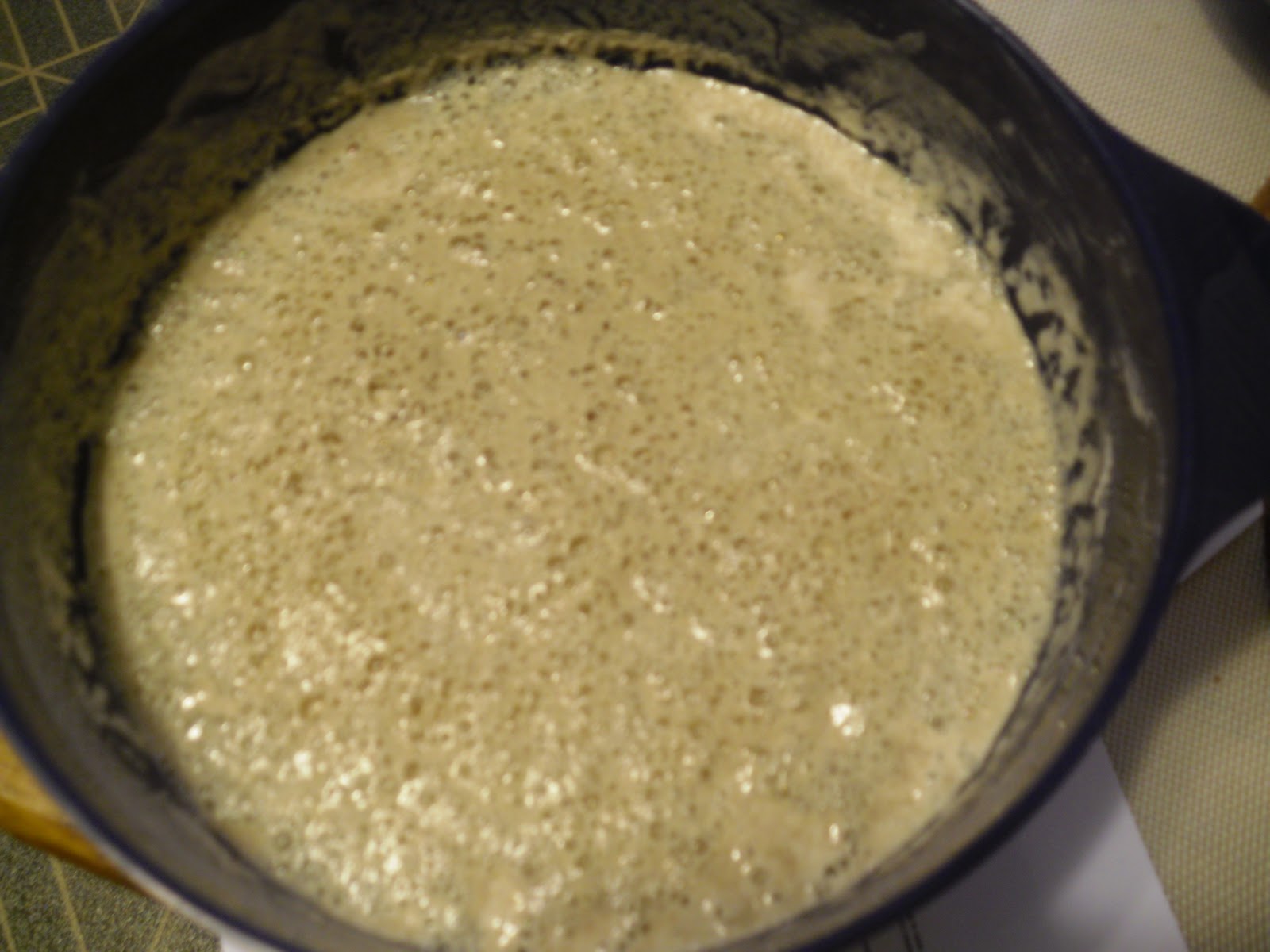
Perhaps I was just delusional, but I thought I saw bubbles start forming almost immediately!  So I decided to check just now.  In the time it took me to start this post, text with my husband about whether he remembered to give the Ethiopians' pictures to their teacher (their first homework assignment), drop a pewter mug on the computer tower causing said computer to spew out a blue screen of death and restart itself, and finish this post, this is what has happened:


Even to my inexperienced eye, this looks good to me and I am hopeful.  It also smells divine!  For now, though, the lid goes on the pot and it sits on the counter until Sunday (the recipe suggests two to three days of fermentation).  

Of course, the batter is just half of the equation.  It sounds like actually cooking injera can be tough, but I'm keeping my fingers crossed for now!  Stay tuned....